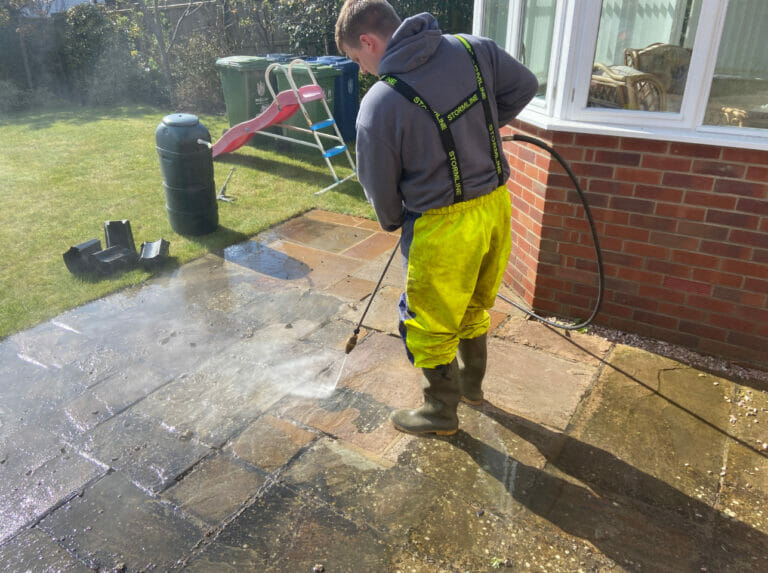
Worried that patio cleaning might damage your lawn, flower beds or garden plants? You are right to ask before booking or trying it yourself.
You can often clean a patio safely around grass and plants, but it depends on the surface, the cleaning method, the products used, the drainage, and how carefully you protect the area.
The main risk is not usually the pressure washing itself. The bigger risk is chemical runoff, overspray or using a strong patio cleaner too close to lawns, borders, ponds or delicate planting. That does not mean patio cleaning is a bad idea. It means the job needs planning.
For many homes in Cambridge and the surrounding villages, a careful patio clean can remove dirt, algae, moss and slippery build-up without ruining the garden around it. The key is to choose the right method for the paving and the garden around it.
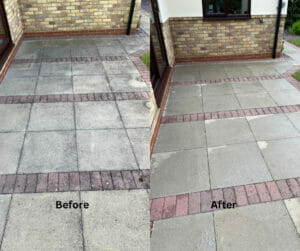
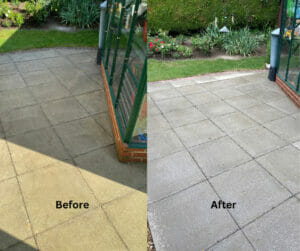
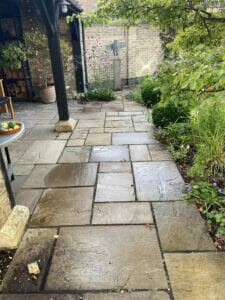
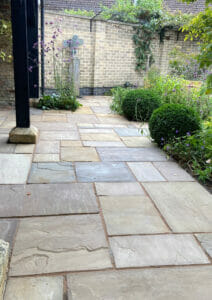
Before and after images of a patio cleaning we did at the beginning of this year, stunning and no damage to plants or grass!
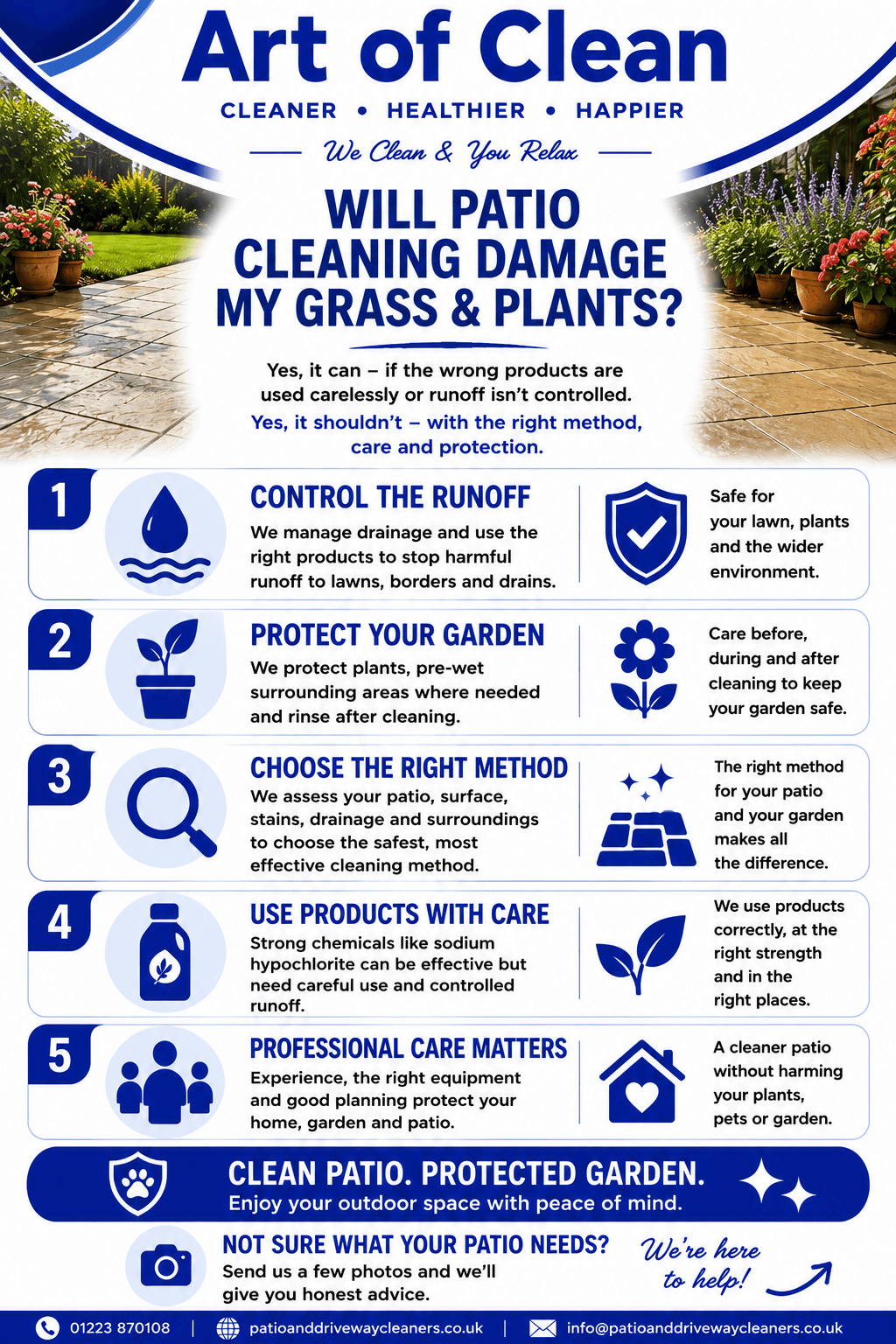
Quick answer: can patio cleaning damage grass and plants?
Yes, it can, if the wrong product is used carelessly or runoff is not controlled.
No, it should not, if the patio is assessed properly, plants are protected, products are used carefully, and the area is rinsed well afterwards.
Grass and plants are most at risk when strong chemical cleaners sit on leaves, soak into borders, or run into lawns in concentrated amounts. Sodium hypochlorite, which is used in many exterior cleaning products, can be very effective on organic staining such as algae, lichen and black spot, but it needs to be handled with care.
You can read more general safety information about sodium hypochlorite on the GOV. UK sodium hypochlorite information page.
Why patio cleaning can affect plants and grass
A patio clean is not only about the paving. Water and cleaning solution have to go somewhere.
If your patio slopes towards a lawn, border, pond, drain or neighbouring garden, runoff matters. If pots sit close to the edge of the patio, overspray matters. If the patio is surrounded by delicate planting, the cleaning method needs to be chosen with that in mind.
The risk is higher when:
- strong patio cleaners are used too close to planted areas
- grass or borders are not wetted before and after treatment
- runoff is allowed to pool in one place
- products are mixed incorrectly
- bleach-based cleaners are used near delicate plants
- the patio has poor drainage
- the surface needs repeated treatment for black spot or heavy lichen
A good clean should improve the patio without treating the garden as an afterthought.
Is pressure washing safer than using patio chemicals?
Pressure washing can be a good option when the main problem is dirt, loose moss, algae and general outdoor build-up. In some cases, using water and controlled pressure can reduce the need for stronger products.
But pressure washing still needs judgement.
Too much pressure, the wrong nozzle or cleaning too close to the surface can damage softer paving, disturb weak pointing or remove jointing sand from block paving. It can also push dirty water towards borders if the drainage has not been considered.
The safest method is not always “chemical-free” or “maximum pressure”. It is the method that suits your patio, your garden and the result you expect.
For a wider look at outdoor cleaning options, you may find our patio cleaning service page helpful.
What about sodium hypochlorite and patio cleaning?
Sodium hypochlorite is often used in exterior cleaning because it can help break down organic staining, including algae, lichen and black spot. It can make a big difference on suitable surfaces.
However, it is not something to use casually around gardens.
If sodium hypochlorite is used, the surrounding area should be assessed first. Plants may need to be moved, covered where suitable, pre-wetted and rinsed afterwards. Runoff should be controlled as much as possible.
It should also never be mixed with vinegar, acids, ammonia or unknown cleaning products. Mixing products can be dangerous.
This is why we would not suggest throwing a strong patio cleaner over the whole area and hoping for the best. If a patio is close to lawns, borders or sensitive planting, the cleaning plan should reflect that.
Can you clean a patio without bleach-based products?
In some cases, yes.
If the patio mainly has loose dirt, surface algae or light moss, pressure washing and careful rinsing may be enough to make the area look much cleaner. The result may not be as bright as a stronger treatment, especially if there are older black spots or deep organic marks, but it may be the better choice if your planting is the priority.
This is where honest expectation setting matters.
If you want the patio to look as clean as possible, a treatment may be recommended where suitable. If protecting a flower bed, lawn edge or new planting matters more than removing every last mark, say that before the work starts.
A professional patio cleaner should be able to explain the trade-off clearly.
What we check before cleaning near grass and plants
Before cleaning a patio, it helps to look beyond the paving itself.
A careful assessment should include:
- what the patio is made from
- whether the surface is natural stone, concrete, porcelain, block paving or another material
- whether there are loose slabs, damaged pointing or weak joints
- where the water will drain
- whether lawns, flower beds, pots, ponds or wildlife areas are close by
- whether the patio has black spot, algae, moss, rust, oil or general dirt
- whether any products have already been used
- whether re-sanding, pointing or sealing may be needed afterwards
This is especially important around Cambridge gardens where patios often sit close to lawns, borders, pots and shaded planting. A small courtyard in the city, a family patio near Ely or a larger garden patio near St Ives can all need a slightly different approach.
If black spots are part of the problem, our guide to black spots on patio slabs explains why those marks often need more than a quick rinse.
How plants and lawns can be protected during patio cleaning
There is no single method that fits every garden, but sensible plant protection usually starts before cleaning begins.
Move pots, planters, garden furniture and loose items where possible. Sweep away leaves, soil and debris so the patio can be assessed properly. If plants are close to the work area, they may need to be wetted before cleaning starts and rinsed afterwards. Delicate areas may need extra care or a different cleaning approach.
The goal is to avoid concentrated cleaner sitting on leaves, soaking into soil or draining into the wrong place.
If a patio sits directly above a flower bed or slopes into a lawn, tell the cleaning team before the work begins. If there is a pond, water feature or vegetable bed nearby, mention that too.
Will my lawn die after patio cleaning?
A lawn should not die simply because a patio has been cleaned properly nearby.
Problems are more likely when strong cleaner runs onto the grass in a concentrated form or is left there without being diluted and rinsed. Grass can be more forgiving than some delicate plants, but it is still living material and should not be treated as a drain.
If you are cleaning the patio yourself, do not assume rain will solve the problem. Read the product label, protect the garden, and avoid using a stronger mix than recommended.
If you are not sure what the patio needs, ask for advice before applying anything.
What if I have flower beds right next to the patio?
Flower beds need more care than open paving.
Some plants are more sensitive than others, especially soft-leaved plants, young plants, herbs, vegetables and anything recently planted. If a border sits right against the patio edge, it may be better to accept a more controlled clean rather than chasing a flawless finish at all costs.
A few remaining marks on the paving may be a better outcome than harming planting you have spent months or years looking after.
That does not mean the patio cannot be improved. It means the cleaning method should be chosen with the whole garden in mind.
Should I clean the patio myself or use a professional?
For a small, sound patio with light dirt and no sensitive planting nearby, a careful homeowner may manage a basic clean.
Professional help becomes more useful when the patio is large, heavily soiled, slippery, close to planting, affected by black spot, made from natural stone, poorly drained or already damaged. It is also worth getting advice if you are not sure what products have been used on the surface before.
A professional clean should not start with maximum pressure or the strongest product. It should start with a proper look at the surface and the surroundings.
If your driveway also needs attention, our driveway cleaning service page explains how different surfaces and joints may need different care.
What results should you expect?
Patio cleaning can make a big difference, especially where the surface is covered in algae, moss, dirt and general weathering. It can make the patio look brighter and feel more pleasant to use.
But it is not always realistic to promise a perfect, new-looking surface.
Some marks are deeper than they look. Some staining has been there for a long time. Some surfaces are porous, worn or previously treated. Some patios can be cleaned very well, while others need a more cautious approach because of the paving, the joints or the garden around them.
The right result is not just the cleanest possible patio. It is the best clean that makes sense for the surface, the garden and how you use the space.
A short Video on how we care for your patio:
How to reduce the risk before your patio clean
Before your patio cleaning appointment, a little preparation can help.
Move lightweight pots and garden furniture if you can do so safely. Let the team know about any delicate plants, new turf, ponds, herbs, vegetable beds or areas that do not drain well. If your patio is used by children or pets, mention that too.
It also helps to send photos when you enquire. A few clear images of the patio, the stained areas and the edges near grass or planting can help the team understand what is likely to be needed.
For more general advice, you can browse our Knowledge Centre.
Patio cleaning in Cambridge with garden care in mind
If you are based in Cambridge, Ely, Huntingdon, St Ives or the surrounding villages, and you are worried about patio cleaning near grass, plants or flower beds, the best next step is to ask before applying any product yourself.
We can look at the surface, talk through the likely cleaning options, and explain what is realistic. If protecting nearby planting is your main concern, tell us early. We can factor that into the advice and the cleaning method.
A clean patio should help you enjoy your garden, not leave you worrying about the plants around it.
Send us a few photos or ask for a quotation through our Get in Touch page, and we will help you decide the sensible next step.
FAQs
Will patio cleaning kill my grass?
Not if the cleaning is planned and controlled properly. Grass is most at risk when strong chemical runoff is allowed to sit on it in concentrated amounts. A careful clean should consider runoff, rinsing, and nearby lawns before work starts.
Can patio cleaner damage plants?
Yes, some patio cleaners can damage plants if they are used carelessly, applied too strongly or allowed to overspray or run into borders. Always read the label and avoid using unknown products near delicate planting.
Is sodium hypochlorite safe around plants?
You can use it on suitable exterior surfaces if you know how to control it, but it can damage plants if you don’t manage overspray or runoff. If your patio is close to flower beds, lawns, ponds or vegetable areas, ask for advice before using it.
Can you clean my patio without using strong chemicals?
Often, yes. It depends on the surface and the staining. Pressure washing and controlled rinsing may improve many patios, but older black spot or heavy organic staining may need a more targeted treatment. We can explain the options before you decide.
What should I do before a patio cleaning visit?
Move pots, toys and furniture where practical. Tell us about delicate plants, new turf, ponds, herbs, vegetable beds, pets and any drainage concerns. Photos are helpful because they show the surface, the staining and the garden edges.
Patio and driveway cleaning companies:
The cost of patio cleaning:
Reviews about patio and driveway cleaning services:
 Written and edited by Tracey Gilbey, Marketing and Admin Coordinator at Art of Clean.