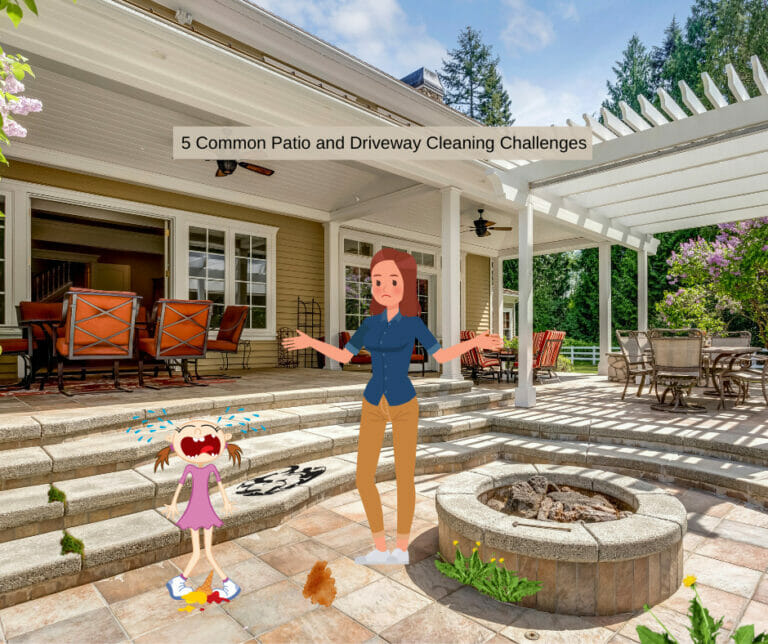
Patios and driveways work hard all year. They deal with rain, leaves, shade, cars, garden furniture, BBQs, foot traffic and the odd spill that no one notices until it has already settled in.
Some marks are simple surface dirt. Others need more care. The useful first step is not to reach for the strongest product you can find. It is to work out what you are dealing with, what the surface is made from and whether the mark is likely to improve with cleaning, treatment or a more careful approach.
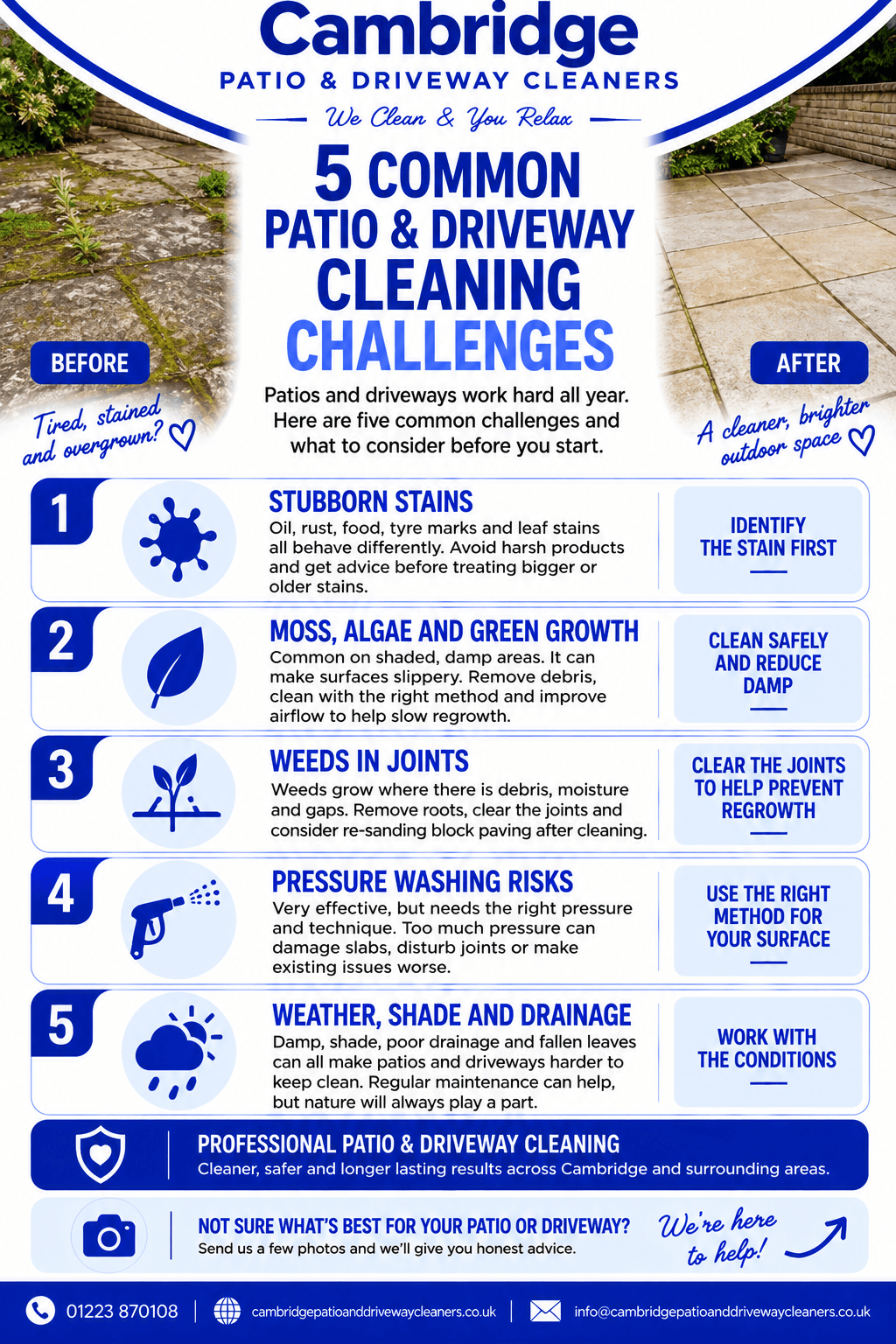
If your patio or driveway is looking tired, here are five common cleaning challenges and what to think about before you start.
-
Stubborn stains on patios and driveways
Not every stain behaves in the same way. Oil, rust, food spills, tyre marks, leaf stains and black spot lichen all need different treatment. A method that helps one stain can be a poor choice for another.
Oil and grease can soak into porous paving, especially on block paving or concrete. Rust often comes from metal garden furniture, BBQs, fire pits, plant pots, tools or products that contain iron. Food and drink spills may sit closer to the surface, but the result still depends on how long the mark has been there and whether anything has already been used on it.
Before scrubbing, take a closer look at the colour, texture and position of the mark. Is it orange or brown? Is it greasy? Is it green and slippery? Is it sitting on top of the surface, or does it look as though it has soaked in?
The safest first step is to avoid making the stain worse. Do not mix several cleaning products, do not use harsh acids on natural stone without proper advice, and avoid heavy scrubbing if you are unsure what the paving is made from.
For larger stains, older marks or visible areas near the front of your home, it may be better to ask for advice before trying different products. A few clear photos can often help us understand whether your patio needs a general clean, a stain treatment or a more careful assessment.
You can also read more about our patio cleaning service if the marks are part of a wider patio clean.
-
Moss, algae and green growth
Green growth is common on shaded, damp or poorly ventilated surfaces. It often appears on patios, paths, steps and driveways where rainwater sits, leaves gather, or the area does not get much sun.
Moss and algae are not only a visual problem. They can make surfaces slippery, especially in wet weather. That matters on steps, entrances, paths and areas used by children, older relatives or visitors.
A stiff brush can help remove loose growth, but it may not deal with growth sitting in joints or rough-textured stone. Pressure washing can improve the surface, but it needs to be done carefully. Too much pressure, the wrong angle or working too close to the surface can disturb joints, damage softer materials or leave uneven cleaning lines.
Vinegar and household mixtures are not always the safe option. They can affect nearby plants, pets, drainage and certain surfaces. The RHS has helpful advice on understanding and avoiding chemical use in the garden, including why household products should not be treated as a harmless shortcut.
A better approach is to remove loose debris, clean the surface using a suitable method, improve airflow where possible and keep leaves from sitting on the paving for long periods. This will not stop nature completely, but it can help slow regrowth.
For more detail on this specific issue, see our guide to removing algae and moss from your patio.
-
Weeds growing through joints and cracks
Weeds usually grow where debris, moisture and gaps give them a place to settle. You may see them between patio slabs, along path edges, through block paving joints or in cracks on older driveways.
Pulling the green top off the weed may make the surface look better for a short time, but it often leaves roots and loose soil behind. That is why weeds can seem to return quickly.
Where practical, remove as much of the root and loose material as you can. A weeding tool, stiff brush and patience can make a difference on smaller areas. On larger patios or driveways, professional cleaning may help clear the surface and remove built-up debris from joints.
The aim is not to just to remove the visible weeds. It is to make the joints cleaner, clearer and less welcoming for regrowth.
On block paving, cleaning may remove old loose sand from the joints. If this happens, the surface may need re-sanding once it is dry enough. Fresh kiln-dried jointing sand can help support the blocks and refill the spaces, but timing matters. If the surface is still damp, the sand may clump rather than settle properly.
If your driveway is block paving, our driveway cleaning service can include advice on whether re-sanding is likely to be needed after cleaning.
-
Tyre marks, oil and driveway stains
Driveways often collect marks that patios do not. Cars, tyres, bikes, bins, garden machinery and tools can all leave stains or dark patches.
Tyre marks may sit on the surface, but oil and grease can be more stubborn. Fresh oil is usually easier to improve than old oil. If a spill has just happened, absorb what you can without spreading it around or pushing it deeper into the paving. Avoid flooding it with water straight away.
Older oil stains can soak into the face of blocks, concrete or porous stone. Pressure washing may clean the surrounding driveway and make the oil stain stand out more, especially if the oil needs a degreasing treatment rather than water pressure alone.
Some stains improve rather than disappear completely. This is especially true where oil has been present for a long time, where the surface is porous, or where products have already been tried.
A professional clean can make the whole driveway look fresher and more cared for, but it is still important to set realistic expectations. We would rather explain the likely result before work begins than promise a perfect outcome that the surface may not allow.
You may find it helpful to look at our patio and driveway cleaning reviews to see what customers often notice after a proper clean.
-
Dirty joints, cracks and tired-looking paving
Sometimes the problem is not one dramatic stain. It is the overall tired look that builds up slowly. Dirt settles into joints, leaves break down, sand becomes loose, weeds appear, and the whole surface starts to look dull.
This is common on older patios and driveways. It does not always mean the surface is beyond saving. In many cases, a proper clean can make the area look brighter and easier to maintain.
The method depends on the surface. Block paving, concrete, sandstone, porcelain, tiles and older slabs all behave differently. Some surfaces can take more cleaning pressure than others. Some need a gentler approach. Some joints may need re-sanding or pointing after cleaning. Some areas may benefit from sealing once the surface is clean and dry.
A good clean should protect the surface as well as improve the look. That means using the right pressure, the right treatment, the right drying time and the right aftercare advice for the material.
If you are comparing options, our guide to patio and driveway cleaning services in Cambridgeshire may help you decide what type of support you need.
When should you ask for professional advice?
There are plenty of small maintenance jobs homeowners can do themselves. Regular sweeping, clearing leaves, removing loose debris and dealing with fresh spills quickly can all help.
It is sensible to ask for advice when:
- The surface is natural stone, old or delicate.
- The stain is large, dark, greasy or rust-coloured.
- The area is slippery.
- Black spots remain after basic cleaning.
- Several products have already been tried.
- Block paving joints look low or loose.
- You are not sure what the surface is made from
The earlier you ask, the easier it is to give useful advice. A clear photo of the whole area, plus a close-up of the mark, can help us understand what may be possible.
A cleaner outdoor space without guesswork
Patio and driveway cleaning is not only about making the surface look brighter. It is about choosing the right method for the stain, the surface and the way the area is used.
You can remove some stains. You can improve some stains. Some stains need treatment and time. Some surfaces need careful handling to avoid damage. That honest assessment is part of doing the job properly.
If your patio, path or driveway is looking tired, send us a few photos or ask for a quote. We can look at the surface, explain what is likely to be needed and help you decide the right next step without pressure.
For advice or a written quotation, contact Cambridge Patio and Driveway Cleaning.
Frequently asked questions
What is the best way to remove stains from a patio?
The best method depends on the type of stain and the surface. Oil, rust, algae, food marks and black spots all need different treatment. It is safer to identify the stain first rather than trying several products and risking damage.
Can pressure washing damage a patio or driveway?
Yes, it can if the pressure is too high or the wrong method is used. Some surfaces, joints and older paving need a more careful approach. Professional cleaning should improve the area without damaging the surface.
Why does moss keep coming back on my patio?
Moss often returns where the area stays damp, shaded or covered with debris. Regular sweeping, clearing leaves and improving airflow can help slow regrowth, but outdoor surfaces will still need maintenance over time.
Can oil stains be completely removed from a driveway?
Some oil stains can be improved, but complete removal cannot always be guaranteed. The result depends on the surface, how long the oil has been there and whether it has soaked into the paving.
Does block paving need re-sanding after cleaning?
Block paving may need re-sanding after cleaning if loose or old jointing sand has been removed. The surface needs to be dry before kiln-dried sand is brushed back into the joints properly.
Check out our reviews and a few other patio & driveway cleaning companies:
To help you find a patio & driveway company in Cambridgeshire, I wrote this blog:
 Written by Tracey Gilbey, Marketing and Admin Coordinator at Art of Clean.